Summary: Selecting the right white-label video consultation platform means looking beyond feature checklists and polished demos. This guide explains which platform decisions are difficult to change after deployment, which can safely evolve over time, and how to evaluate compliance, AI capabilities, branding, and infrastructure with confidence. By focusing on the criteria that have the greatest long-term impact, you’ll be better equipped to choose a platform that supports your business as it grows.
Table of Contents
Introduction
Choosing a white-label video consultation platform has become harder — not because there are too few options, but because many vendors now make similar claims. Security, compliance, AI, customization, scalability, integrations — they all appear on the feature list. The challenge is knowing which of those decisions are difficult to reverse after launch, and which can safely wait.
This guide works through that distinction. If you are earlier in your research and want to understand what white-label video consultation is, what it typically costs, or how it compares to building from scratch, those questions are covered in the related resources at the end of this page.
Key Takeaways
- Not all platform decisions carry the same weight. Prioritize the ones that are hardest to reverse.
- Evaluate for production, not just launch. Think beyond your initial deployment.
- Look beyond AI features. Understand where data is processed and how it is protected.
- Treat demonstrations as a starting point. Ask for evidence, not just promises.
- Ask the right questions early. It is far easier than fixing the wrong decision later.
The Evaluation Framework: Start With What You Can’t Change Later
Not all platform decisions carry the same weight. Some are foundational — baked into the infrastructure from day one and expensive to reverse after deployment. Others are configurable — adjustable as your use case matures without requiring architectural changes.
The mistake most evaluation processes make is treating both categories as equal. A checklist of fifteen criteria with no sense of hierarchy tends to produce decisions optimized for sales performance rather than production reality.
Tier 1 — Decisions That Are Expensive to Reverse
1. Compliance Architecture and Data Handling
This is the first question to resolve — not because compliance is the most exciting criterion, but because it shapes every other decision.
A platform’s compliance posture is not just a box-ticking exercise. It is about whether the platform’s security and data handling architecture covers every component that touches your users’ data — video infrastructure, messaging, session recordings, and any AI processing if that is relevant to your use case. Compliance problems most commonly emerge in production due to the gap between what a platform’s core infrastructure covers and what its peripheral features cover.
The questions worth pressing before any other evaluation criteria:
-
-
- Does the platform’s compliance posture — GDPR, HIPAA, or whatever applies to your industry — extend across every component, not just the core video layer?
- Where is session data stored, and can data residency be specified contractually?
- Who owns the data generated through the platform, and what happens to it after contract termination?
- For healthcare deployments specifically: is the vendor prepared to sign a Business Associate Agreement?
2. Branding Depth
The gap between surface-level white-labeling and genuine brand ownership is significant — and not always visible during a sales demonstration.
Surface-level white-labeling means your logo and color scheme are applied to a fixed interface. Genuine brand ownership means your domain, your identity, and your configuration throughout — including system-generated communications, mobile app metadata, waiting screens, and error states.
The test is straightforward: ask for a live walkthrough of the complete user journey under a test brand, in a standard rather than curated environment. If a vendor cannot demonstrate this before the contract stage, the branded experience you are evaluating is largely hypothetical.
3. Interface Configuration
This one belongs in Tier 1 because it is easy to overlook until it is too late. Interface configuration is not just about how the platform looks; it is about how much of the user journey you can control.
Can your team adjust the sequence of screens? Customize intake flows? Reconfigure the waiting room experience without raising a support ticket? The difference between a platform that lets you do this independently and one that requires vendor involvement for routine changes is significant at scale. If most interface adjustments require a support request or a development engagement, that overhead compounds quickly once you are running a full production workflow.
Ask specifically: what can your team reconfigure without developer resource, and what requires vendor involvement? If the answer is unclear, that is itself an answer worth weighing before you commit.
4. Deployment Model and Infrastructure
Cloud, on-premises, or hybrid — this decision has downstream implications for data residency, security posture, internal IT requirements, and commercial model that are not easily unpicked after go-live.
Cloud deployments offer faster time to market and vendor-managed infrastructure. On-premises deployments offer greater control over data residency and security architecture but require internal resource to manage. When vendors describe a “hybrid” model, it is worth understanding precisely what they mean — the term covers a wide range of actual configurations, and what looks like a middle ground can sit closer to one end than the other.
The infrastructure decision also affects scalability. Confirm not just whether the platform can scale, but what scaling means technically and commercially — whether it requires architectural changes, and whether the commercial model remains proportionate as volume increases.
Tier 2 — Decisions You Can Revisit After Deployment
These criteria matter — but they are genuinely configurable after initial deployment, which changes how much weight they should carry at evaluation stage. The risk with Tier 2 decisions is not making the wrong call early; it is over-investing evaluation effort here at the expense of the Tier 1 criteria that are actually difficult to change later.
5. Integration Capabilities
Integration with your existing CRM, scheduling system, or workflow tools is important to your production workflow — but it is also something that can be extended after go-live rather than something that needs to be fully resolved before a vendor is selected.
The relevant questions at evaluation stage are whether the platform provides API and SDK access for custom integrations, what the vendor’s integration support model looks like, and whether any specific integrations you are depending on at launch are validated in production today rather than on a roadmap. Integrations that are live and documented are more valuable than those described as “in progress” or “available on request.”
6. Feature Set and Roadmap
Evaluate the feature set against your production requirements — not just your launch requirements. The features that matter at pilot stage are often different from the ones that matter at scale, and evaluating only against what you need on day one is a common source of friction six months later.
On roadmap items: if a feature you are depending on is not generally available in production today, establish what the position is if it is delayed or deprioritized. Roadmap commitments that exist only in a conversation are not commitments. If a feature is material to your decision, ask what written confirmation of its delivery timeline looks like.
7. Support Model
Evaluate the support model against your deployment phase, not your steady-state operating phase. Post-launch technical support matters, but the support that has the most impact on outcomes is implementation support — active vendor involvement during configuration and go-live, when the most consequential decisions are being made.
Ask specifically what implementation support looks like, who provides it, and whether it is included in the commercial model or separately scoped. A vendor with a strong post-launch support offering but limited implementation involvement is a different proposition from one that stays close through the go-live period.
Evaluating AI Capabilities
AI has become a standard part of the white-label video consultation platform conversation — but the way vendors describe AI capabilities varies enough that the same terminology can mean very different things in practice. This section is relevant if AI features are part of your requirements. If they are not, skip ahead.
Native AI vs Assembled AI: Why the Distinction Matters
A platform with native AI capability means the AI features operate within the same infrastructure boundary as the video and messaging layer. Data generated during a consultation — intake responses, transcripts, session summaries — is processed within the platform’s existing architecture, subject to the same security controls, and covered by the same compliance framework.
A platform with assembled AI capability means one or more AI features are powered by third-party models or services that sit outside the platform’s primary infrastructure. Data leaves the platform boundary for processing, and the compliance coverage, data handling terms, and security posture of that third-party processing are separate from the platform’s core setup.
To make this concrete: imagine a clinician generates a consultation summary at the end of a session. Whether that summary is produced within the platform’s existing compliance boundary, or transmitted to an external AI provider operating under separate contractual terms, is a material distinction — particularly for healthcare organizations with HIPAA obligations or any deployment where data residency matters. In a sales demonstration, both scenarios can look identical.
Most platforms will describe their AI features in terms of what they do. Few will volunteer where the data goes during processing unless asked. That question should be asked before the commercial discussion begins.
Before any other AI evaluation criteria, establish this: are the AI capabilities being demonstrated covered under the same compliance and security framework as the rest of the platform, or do they require a separate assessment?
What Goes Wrong: Common Mistakes in Platform Selection
Most platform selection mistakes do not become visible at launch. They surface six to twelve months later, when usage patterns diverge from the assumptions on which the evaluation was built.
Evaluating against launch requirements rather than production requirements
The configuration that gets you to go-live and the configuration that supports your full production workflow are often different. Teams that evaluate platforms against their minimum viable launch — the features they need on day one — frequently find that the platform handles early-stage usage well but encounters friction as the use case matures.
Map your full production workflow before you begin evaluating vendors, not after you select one. What does the consultation journey look like at three times your launch volume? What integration points become critical when your team is running hundreds of sessions a week rather than dozens? Evaluate against those requirements, not just the ones that get you to launch.
Treating the sales environment as representative of production
Vendor demonstrations are optimized for clarity and speed. What they do not show is how the platform behaves under real load, how configurable the interface actually is once you move beyond a curated brand setup, or how the support model operates once the contract is signed.
The most useful thing you can ask at evaluation stage is to see the platform running under a test brand in a standard environment. If that is not possible before contract stage, the experience you are evaluating is not fully representative of what you are buying.
Skipping the compliance architecture conversation until late in the process
Compliance architecture often enters the evaluation process late — typically at the legal review stage, after a preferred vendor has already been identified commercially. By that point, discovering gaps in data handling coverage creates pressure to proceed anyway rather than restart the evaluation.
The compliance conversation should happen at the same stage as the initial demonstration. Ask what the platform’s compliance posture covers and what it excludes. Ask about data residency, retention, and — for healthcare — the Business Associate Agreement, before any commercial discussion begins.
Confusing scalability claims with scalability evidence
Every vendor claims their platform scales. The relevant question is not whether the platform can scale in principle, but how it has scaled in practice — under what load conditions, with what infrastructure changes, and with what commercial implications.
Ask for evidence rather than assertions. What is the largest deployment the vendor currently supports? How did the commercial model change as that deployment grew? Answers to these questions tell you considerably more than any capability statement.
Selecting on feature breadth rather than workflow fit
Platforms with the longest feature lists are not always the platforms that best support your specific workflow. A comprehensive feature set that requires significant configuration or vendor involvement for routine changes can create more operational overhead than a more focused platform that supports your core workflow natively.
The evaluation question is not “does this platform have everything?” but “does this platform support our specific workflow without requiring us to build around its limitations?” Those are different questions, and they often have different answers.
The white-label video consultation platform market in 2026 offers more options than it did two years ago — and more variation in what those options actually deliver. The vendors that perform well in demonstrations are not always the vendors whose platforms hold up in production. The features that look most impressive at evaluation stage are not always the ones that matter most six months after go-live.
Good platform evaluations are not about asking more questions. They are about asking the right questions early enough that the answers can still influence the decision.
QuickBlox and Q-Consultation
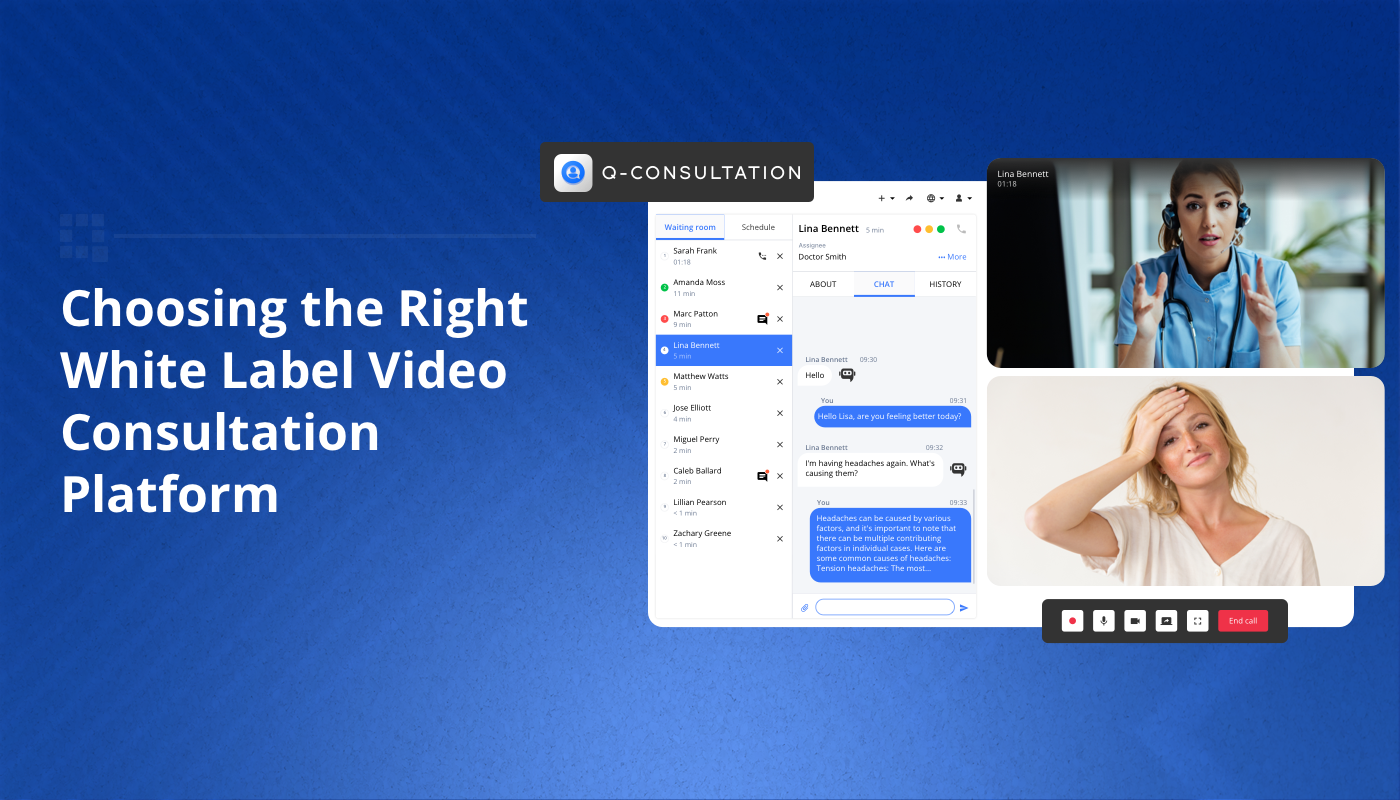
QuickBlox builds the communication infrastructure that powers white-label video consultation deployments across healthcare, financial services, HR, and professional services. Q-Consultation is our AI-powered white-label video consultation platform — deployable under your own brand, with AI capabilities including automated intake, real-time transcription, session summaries, and human handover, all native to the platform infrastructure and covered under a single compliance framework.
If you are at the evaluation stage and want to work through the criteria in this guide against your specific requirements, get in touch.
Related Resources
If you are earlier in your evaluation, the following pages cover the foundational questions:
 AI Agent — automate conversations and workflows. Now available on Free plan