AI Agent — automate conversations and workflows. Now available on Free plan



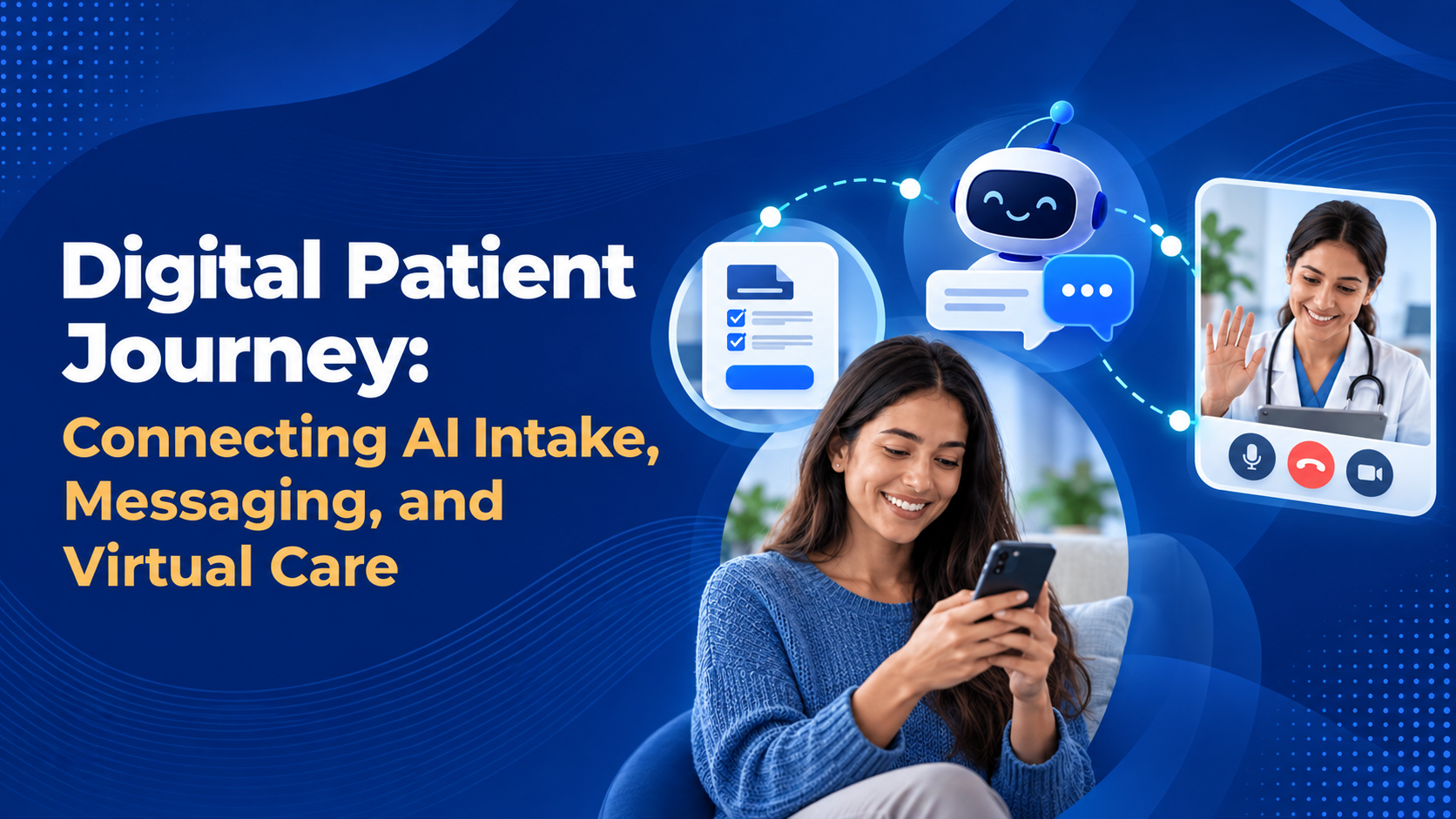
Introduction: A Digital Journey Can Still Feel Disconnected
Alex has been experiencing persistent anxiety and decides to look for online therapy.
They visit a provider’s website, where an AI agent asks what kind of support they are seeking. Alex explains their concerns and answers several preliminary questions. The agent directs them to an intake form, which asks for much of the same information.
Later, an intake coordinator sends Alex a message requesting further details. After an appointment is scheduled, Alex receives an email containing a link to a separate video platform. When the virtual consultation begins, the therapist asks: “What brings you here today?”
Every stage of Alex’s experience is digital. But it does not feel connected.
The patient has become responsible for carrying information between systems, remembering what has already been shared, and working out what happens next.
Alex is fictional, but the experience is familiar. Although this article uses online mental healthcare to make the problems concrete, the underlying issues apply throughout healthcare—from primary care and specialist referrals to chronic care and post-discharge support. For a closer look at this particular care setting, see our guide to the benefits, evidence, and key considerations surrounding telehealth for mental health.
A successful digital patient journey is not simply a sequence of online touchpoints. It is a connected experience in which relevant identity, information, context, and responsibility move forward with the patient. Creating that continuity is one of the central purposes of modern patient engagement software.
Key Takeaways
- Digital does not automatically mean connected. Online intake, messaging, and video can still create a fragmented experience when information and context do not move between them.
- Disconnected systems impose a continuity tax. Patients pay through repeated questions, additional logins, channel switching, unclear instructions, and uncertainty about what happens next.
- The right context should move with the patient. Each person or service needs the relevant identity, intent, information, status, responsibility, and next step—not unrestricted access to the complete record.
- AI agents should advance the patient’s request. They create value when they collect, summarize, route, and transfer useful context rather than adding another isolated conversation.
- Measure transitions as well as individual touchpoints. Repeated data entry, failed handoffs, unnecessary channel changes, and abandonment between steps reveal whether the experience is genuinely connected.
The Continuity Tax: When Patients Become the Integration Layer
Healthcare organizations often measure digital progress by counting the interactions they have moved online:
- appointments booked;
- forms completed;
- messages sent;
- virtual visits delivered;
- reminders automated;
- portal accounts activated.
These are useful measures, but they do not show how the complete experience feels to the patient.
A healthcare organization may have digitized every stage and still require patients to move between disconnected systems. When that happens, the patient becomes the integration layer.
We can think of the resulting burden as a continuity tax: the additional work patients perform because separate tools, channels, and teams cannot carry the right context forward.
Patients pay this tax whenever they must:
- provide the same information more than once;
- repeat a sensitive or complicated story;
- create another account;
- search for an appointment link;
- move from an AI agent to a person without the conversation following them;
- contact the organization to discover what happens next;
- reconcile conflicting instructions from different channels.
In mental healthcare, that repeated effort can be particularly noticeable. Explaining an insurance number twice is frustrating. Repeatedly describing why you are seeking emotional support may feel discouraging or impersonal.
The same principle applies across the patient journey in healthcare. A person managing a chronic condition should not have to repeat recent symptoms every time they move from monitoring to messaging. Someone referred to a specialist should not have to reconstruct information that has already been collected. A patient leaving hospital should not need to determine which system owns their follow-up.
The digital experience is only as connected as the transitions between its parts.
The effects are visible in patient communication. In an Artera survey of more than 2,000 patients, 68% reported receiving repetitive messages from providers across different channels, while 65% had received messages that were out of order or jumbled. These are not simply messaging problems. They are signs that sequence and context are being lost as the patient moves between systems.
The challenge, however, is not to avoid specialist tools. It is to ensure that adding them does not add more work for patients and staff. A well-designed patient communication platform can help by bringing channels, conversation history, routing, and staff ownership into a more manageable environment. When evaluating vendors, our comparison of the best patient engagement platforms shows how the main platform models differ in the parts of the journey they connect.
Four Moments When Patients Are Asked to Start Again
The most revealing parts of a digital healthcare journey are often not the individual interactions. They are the moments when the patient moves from one interaction to another.
Four transitions regularly determine whether an experience feels connected.
“Tell us why you’re here”
Alex initially explains their reason for seeking therapy to an AI agent. The agent asks about the kind of support they are looking for, their availability, and whether they have any provider preferences.
That interaction appears useful—until the intake form begins with the same questions.
Repetition can affect more than patient satisfaction. According to a 2026 Tebra survey of 703 U.S. patients, 92% are asked to complete the same intake paperwork at least once a year, while 19% say they have supplied inaccurate or incomplete information because the process felt repetitive or rushed. More strikingly, 27% have delayed, canceled, or avoided an appointment to escape the paperwork.
Digital intake may remove the clipboard, but it does not remove the burden if previously supplied information cannot follow the patient into the next interaction. Moving intake online should do more than replace a paper form with a digital one: it should collect information that prepares the next interaction.
Depending on the use case, intake might capture:
- the reason for contacting the organization;
- relevant symptoms or concerns;
- contact, service, and communication preferences;
- appointment, consent, or insurance information;
- responses requiring staff review.
An AI agent can make this process more conversational. It can ask an appropriate follow-up question, identify missing information, explain why something is being requested, and adapt the workflow according to the patient’s answers. For a closer examination of this first stage, see how AI-powered patient intake collects, structures, and routes information before care.
But the value does not come from the conversation alone. It comes from what happens to the information afterwards.
Organizations need to decide:
- What information should be retained or used to prefill later steps?
- Who needs to review it?
- What action should it trigger?
- What happens when a response falls outside the agent’s approved scope?
If Alex provides useful information to an AI agent but no one else can access it, the interaction has added another digital touchpoint without moving the care process forward.
“Can you explain that again?”
After completing the intake, Alex receives a secure message from a coordinator. The coordinator can see the form but not the earlier AI conversation, so Alex is asked to explain part of the situation again.
Later, the therapist receives the appointment details but only a short administrative note.
This is where disconnected systems turn repetition into something more consequential. Patients may begin to wonder whether anyone has reviewed what they shared or whether important information has been lost.
Digital communication creates another restart when patients cannot finish a task in the channel where it began. In Artera’s survey, 31% of patients said that texting failed to achieve what they wanted at least half the time. Among those patients, 81% ultimately had to call the provider to complete the conversation. Instead of reducing effort, the digital interaction created another handoff—and potentially another explanation from the beginning.
A connected experience does not require every employee to see every conversation. It requires the person responsible for the next action to receive the relevant context.
When an interaction moves from an AI agent to a staff member, that context may include:
- the patient’s verified identity and reason for contact;
- relevant answers, documents, or images already provided;
- the task the patient is trying to complete;
- areas of uncertainty or reasons for escalation;
- what the patient has already been told.
The same principle applies when a message moves between administrative and clinical teams. A scheduling question, billing issue, medication request, and symptom update may require different owners. Effective routing should move both the request and enough context to act on it.
Patients should not have to serve as the only record of the conversation.
This does not mean sharing information indiscriminately. Sensitive healthcare information should be available only to appropriately authorized people and systems. Continuity depends on purposeful context: providing the minimum relevant information needed to complete the next action safely and effectively.
“Use this new link to join”
Alex’s appointment is confirmed through the portal, but the consultation takes place in a different video service. The joining link arrives by email.
On the day of the appointment, Alex is uncertain whether to enter through the portal or the email. The video service requests a display name but does not appear to recognize the intake already completed.
The video call itself may work perfectly. The transition into it does not.
A virtual patient journey should connect preparation, communication, and consultation rather than treating video as an isolated event.
Before the appointment:
- confirm attendance and complete required intake;
- receive preparation instructions;
- ask questions or test access.
During the appointment:
- join through a clear, authenticated route;
- receive technical help or reconnect if needed;
- use messaging and file sharing when appropriate.
After the appointment:
- receive summaries, instructions, and follow-up reminders;
- schedule the next step;
- continue an appropriate secure conversation.
Messaging, intake, and video should therefore be designed as parts of the same workflow. The patient should not need to determine which system contains the “real” appointment or whether information entered before the consultation has reached the provider.
Our guide to patient portal integration explains how EHRs, AI agents, messaging, and telehealth can be connected behind that experience.
A smooth video connection is important. A smooth transition into and out of the consultation is what makes it part of a connected patient journey.
“What happens next?”
The consultation ends, and Alex is told that someone will be in touch about a follow-up appointment.
A short summary appears in the portal. A reminder arrives by text. Alex is unsure whether they can reply to the text, message the therapist directly, or wait for the scheduling team.
Nothing has technically failed. But responsibility for the next step is unclear.
Healthcare organizations often invest heavily in helping patients reach an encounter, then give less attention to what happens after it. After an encounter, a patient may need to follow instructions, complete a task, monitor symptoms, arrange another appointment, share an update, or ask for clarification.
The system should make three things clear:
- What happens next?
- Who is responsible for making it happen?
- What should the patient do if it does not happen?
For Alex, this could mean receiving a follow-up message in the same secure environment used before the consultation, with clear information about scheduling and appropriate communication between sessions.
In another care setting, it might mean a medication reminder, a post-discharge check-in, an invitation to report symptoms, or instructions for arranging a test.
The specific action changes. The need for visible continuity does not.
What Must Travel With the Patient?
A connected digital health patient journey does not require every system to hold the complete medical record. Each service needs the information necessary to perform its role and prepare the next step.
Six types of context are particularly important.
Identity
Who is the patient, and how has their identity been verified?
Identity should remain consistent as the patient moves between intake, messaging, and virtual care. Appropriate arrangements may also be required for guardians, caregivers, or proxies.
Intent
What is the patient trying to accomplish?
A request to find a therapist, reschedule an appointment, discuss a symptom, or obtain technical help should not arrive at the next stage as an unexplained conversation.
Information
What relevant details has the patient already provided?
This may include intake responses, communication preferences, uploaded files, selected services, or recent messages. Only information appropriate to the next task should travel forward.
Status
What has already happened?
The next person or system may need to know whether:
- intake or consent is complete;
- an appointment is confirmed;
- a request has been reviewed;
- the patient is awaiting a response;
- an action has failed or remains incomplete.
Responsibility
Who or what owns the next action?
A connected workflow should not leave a message, referral, or follow-up task available to everyone but assigned to no one.
Next step
What has the patient been told to expect?
The instructions visible to staff should align with those given to the patient. Otherwise, even a technically integrated system can create confusion.
Together, these elements form a small continuity package. They allow the next interaction to begin where the previous one ended.
Use AI to Preserve Context, Not Add Another Voice
AI patient engagement can improve a digital patient care journey, but only when AI agents connect with the services and people around them.
A well-integrated AI agent might:
- answer routine service questions;
- collect or complete missing information;
- summarize and classify an interaction;
- route the request with relevant context;
- remind the patient of an unfinished action;
- identify uncertainty and involve staff.
These are examples of the wider workflows a healthcare AI agent can support when it is connected with communication channels, organizational knowledge, and human teams.
In Alex’s case, an AI agent could explain available therapy services, collect preferences, guide the intake process, and prepare a structured summary for the coordinator.
It should not independently diagnose Alex, determine treatment, or create the impression that an urgent situation is being clinically monitored when it is not.
A poorly connected AI agent can actually increase the continuity tax. It may conduct a polished conversation but then:
- repeat questions already answered;
- provide guidance disconnected from the next action;
- transfers the patient without context;
- create a request that nobody owns;
- fail to explain what happens next.
The most useful measure of an AI agent is therefore not simply how many conversations it handles or how many questions it answers.
Ask instead:
- Did the interaction advance the patient’s request?
- Did it reduce repeated work?
- Did the correct team receive useful context?
- Did the patient understand the next step?
- Could a person enter without starting over?
AI should help maintain continuity across the experience—not become another voice the patient must brief.
Design Around the Next Step, Not the Current Touchpoint
Disconnected experiences often emerge because different teams optimize the individual interaction they control.
The intake team improves form completion. The communication team improves message response rates. The telehealth team improves successful video connections. The AI team improves automated resolution. The clinical team focuses on the consultation.
Each improvement may be worthwhile. But the patient experiences all of them as one healthcare patient journey.
Every team should therefore ask a question beyond its immediate task:
What will the patient need to do next, and what must move forward so they can do it without starting again?
Several practical principles follow.
Collect information once and reuse it appropriately
Do not ask patients to re-enter information merely because another tool owns the next stage. Prefill, transfer, or summarize data where appropriate and authorized.
Make the next action explicit
Every interaction should end with a clear status or next step. “Someone will contact you” is less useful than explaining who will respond, through which channel, and within what expected timeframe.
Give every interaction an owner
Messages, transfers, and follow-up tasks should enter a defined queue or workflow. Shared visibility is valuable, but shared visibility without assignment can still result in inaction.
Preserve context when the channel changes
A patient may begin in web chat, continue through secure messaging, and move into video. The channel can change, but the purpose and relevant history of the interaction should not disappear.
Design the exception path
Real patients do not always follow the expected route. They may provide an ambiguous answer, abandon a form, miss an appointment, lose a connection, or send a request through the wrong channel.
A mature digital experience explains what happens when the ideal workflow breaks.
Keep a human route visible
Automation should not trap patients inside a process that cannot address their needs. Organizations should define when staff become involved and what information they receive. This includes configuring an effective AI-to-human handoff in healthcare so that the patient, conversation context, and responsibility move together.
This is particularly important in mental healthcare, where language may be ambiguous and some responses may require timely human review. The precise escalation process depends on the service, clinical model, jurisdiction, and organizational policy. It should be designed before the AI agent or messaging workflow is deployed.
Measure the Number of Restarts
A healthcare organization cannot determine whether it has created a connected experience by measuring channel activity alone.
High form completion, message volume, or video utilization may show that individual tools are being used. They do not reveal how much effort patients expend moving between them.
Useful continuity measures may include:
- repeated data entry or requests for information already collected;
- accounts, logins, and channel changes required;
- abandonment between important steps;
- incorrectly routed or repeatedly transferred requests;
- transfers completed without usable context;
- time from initial contact to the appropriate next action;
- successful completion of consultation and follow-up workflows.
Appointment completion illustrates why the steps after booking also matter. In one hospital study, appointments made online or through the call center had a no-show rate of approximately 11–12% before optimization. After the hospital introduced AI-based no-show prediction and backup scheduling, realized appointments increased by approximately 10% per month, while capacity utilization improved by around 6%. The intervention did not isolate chatbot bookings or prove that disconnected experiences caused the missed visits, but it shows that managing what follows a booking can materially affect whether scheduled capacity becomes delivered care.
Qualitative feedback is equally important. Ask patients:
- Did you know what would happen next?
- Did you have to repeat information?
- Did staff appear to understand why you were contacting them?
- Did the transitions into consultation and follow-up feel connected?
Staff should be asked parallel questions:
- Did you receive enough context?
- Could you see what the patient had already completed?
- Was the request routed to a clear owner?
- Did the workflow reduce work or merely move it elsewhere?
These answers can reveal problems that channel-level metrics overlook. Organizations should examine what happens between measured touchpoints, not just whether each individual interaction was completed.
A shorter form is not enough if the patient must complete another form afterwards. A fast response is not enough if the message reaches the wrong team. A successful video connection is not enough if the clinician lacks the information collected before it.
Conclusion: Build Continuity Into Every Step
QuickBlox helps healthcare organizations build connected experiences across AI intake, secure messaging, and virtual care. Our communication infrastructure, AI agents, and integration options let you add these capabilities to an existing healthcare application or service and build a connected patient engagement platform.
For organizations that want a ready-made starting point, Q-Consultation for Healthcare combines configurable intake, secure chat, video consultations, and AI-supported workflows in a branded digital environment.
A successful digital patient journey is not defined by how many interactions happen online. It is defined by how easily patients can move between them—without repeating their story, losing context, or having to work out what happens next.
Additional Resources
Explore these related guides for more information about the technology, workflows, and safeguards involved in delivering connected digital care: