AI Agent — automate conversations and workflows. Now available on Free plan



Introduction
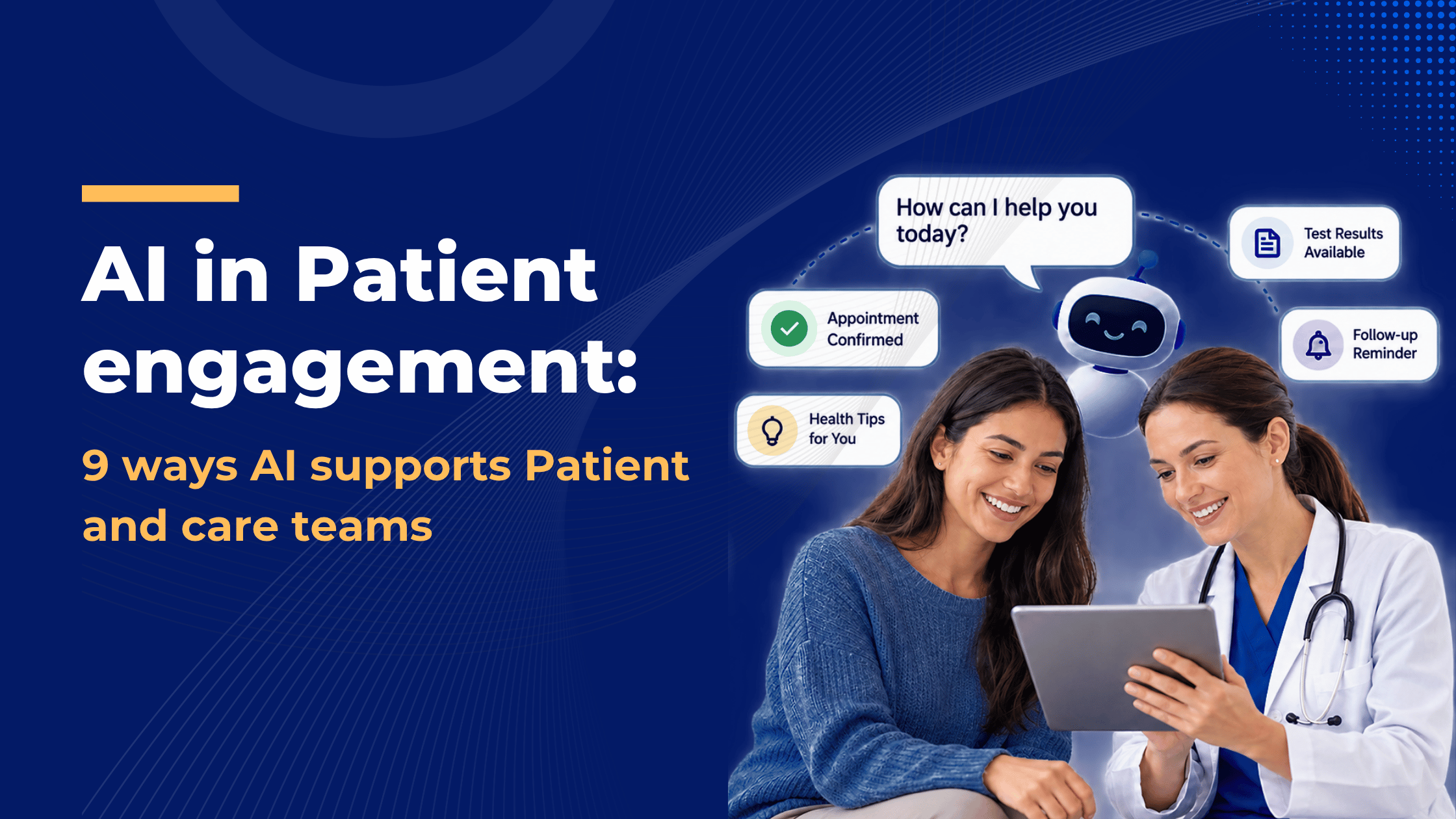
AI is rapidly becoming part of how healthcare organizations communicate with patients. It can respond to routine questions, collect information before an appointment, help people navigate services, prepare summaries for staff, and maintain contact after an interaction. But its value does not come from automating every conversation. This helps explain why patient engagement platforms are increasingly incorporating AI capabilities: healthcare organizations want patient interactions to become more responsive without creating unmanageable work for care teams.
Patient interactions differ in complexity, sensitivity, and consequence. Sending an appointment reminder is very different from responding to an ambiguous symptom description. Organizing an intake form is different from deciding what the information means. In some situations, AI can complete a task independently. In others, it should assist a member of staff or recognize that responsibility must move to a person.
The most useful way to understand AI in patient engagement is therefore to look at the roles it can perform. AI can answer, collect, personalize, recommend, remind, route, summarize, identify uncertainty, and escalate. These roles can reduce avoidable work and make services easier to access—but only when they are connected to appropriate information, systems, and human oversight.
This article examines each role, where it can add value, and how healthcare organizations can decide whether AI should automate an interaction, assist a person, or step aside.
Key Takeaways
- AI can support patient engagement by answering, collecting, personalizing, recommending, reminding, routing, summarizing, identifying uncertainty, and escalating.
- Predictable, clearly bounded interactions are the strongest candidates for automation.
- AI can assist healthcare teams with summaries, message organization, information retrieval, and response preparation while people retain responsibility.
- AI should recognize when it lacks the information, authority, certainty, or sensitivity needed to continue.
- Successful AI patient engagement depends on approved information, defined boundaries, system integration, human oversight, and reliable escalation.
What Is AI in Patient Engagement?
AI in patient engagement is one application of AI in healthcare: the use of artificial intelligence to support interactions between patients and healthcare organizations. These interactions may take place through a website, chatbot, patient portal, mobile application, SMS conversation, voice channel, or virtual-care platform. AI operates through communication channels rather than replacing them. Our guide to patient communication platforms explains how messaging, voice, chat, and video can connect patients with healthcare teams and operational systems. AI is one capability within broader patient engagement software, which may also connect scheduling, intake, communication, virtual care, follow-up, and ongoing support.
The technology can include conversational AI that interprets free-text questions, language models that generate or summarize content, speech recognition for voice and video interactions, and workflow logic that connects a conversation with another system or team. Some applications are patient-facing. Others work behind the scenes by organizing information or assisting staff. When the system can interpret patient input, use connected information, and initiate approved actions across a workflow, it may function as a healthcare AI agent.
This makes AI broader than conventional patient engagement automation. A traditional automated system may send a reminder at a fixed time or present a predetermined menu. An AI-enabled system can interpret less structured input, adapt its response to context, extract relevant information, and determine which approved action should happen next.
That flexibility creates new possibilities, but it also makes boundaries important. AI should be given a clearly defined role rather than open-ended responsibility for the complete interaction. The World Health Organization’s guidance on AI for health emphasizes that ethics, human rights, accountability, and responsiveness to affected people should remain central to the design and use of these systems.
9 Ways AI Supports Patient Engagement
How is AI used in healthcare patient engagement? In practice, its contribution can be understood through nine roles. They are not nine isolated product features, and not every organization will need all of them. A useful implementation begins with a specific patient or operational problem and selects only the capabilities needed to address it.
- Answer
Patients regularly contact healthcare organizations with questions that do not require individual clinical judgment. They may want to know when a location opens, which services are available, what to bring to an appointment, how to join a virtual consultation, or where to find an approved form.
AI can make that information available conversationally. Instead of navigating several pages or waiting for office hours, a patient can describe what they need in their own words and receive a relevant response.
The quality of this role depends on the source material. An AI agent should answer from current, approved organizational content and stay within its defined subject area. It should not improvise an answer when information is unavailable or turn an administrative conversation into unapproved medical advice.
- Collect
AI can gather information through a conversation rather than requiring every patient to complete the same static form. Depending on the workflow, this might include contact details, the reason for an appointment, relevant history, current medication information, consent acknowledgements, or answers to standard pre-visit questions.
Conversational collection allows the system to ask an approved follow-up question when an answer is incomplete or unclear. It can also confirm what it has understood before submitting the information.
Collection should still have a defined purpose. Organizations need to decide which information is necessary, where it will be stored, who can access it, and what happens after submission. An engaging conversation is of limited value if staff must copy its contents manually into another system or cannot tell whether the intake is complete.
- Personalize
Generic communication often asks patients to work out which information applies to them. AI can make an interaction more relevant by using appropriate context such as the service requested, appointment type, preferred language, location, or information already supplied during the conversation.
A patient preparing for a video consultation may need different instructions from someone attending a clinic. A returning patient may not need the same onboarding explanation as a new patient. Someone who has already completed a form should not continue receiving prompts to submit it. Carrying that information forward is also essential to a connected digital patient journey, particularly when patients move between AI intake, messaging, staff support, and virtual care.
Personalization should be purposeful and proportionate. It does not mean giving the AI unrestricted access to the patient record or allowing it to invent individualized clinical guidance. The system should use only the context required for the approved interaction and make clear when information is general rather than specific medical advice.
- Recommend
Within defined boundaries, AI can recommend an appropriate administrative next step. It might direct a patient to the correct service, present suitable appointment options, identify the relevant preparation instructions, or explain which approved communication channel to use.
This is different from independently recommending a diagnosis or treatment. In patient engagement, the safest and most useful recommendations are usually constrained by organizational rules. The AI is helping the patient navigate options the healthcare organization has already defined.
The distinction matters because a conversational response can sound authoritative even when the underlying system lacks the information or permission to make a consequential decision. Organizations should specify what the AI may recommend, what requires confirmation, and which requests must move to a qualified person.
- Remind
Reminders are one of the most established forms of patient engagement automation. Healthcare organizations use them to confirm appointments, prompt patients to complete forms, share preparation instructions, encourage an agreed follow-up action, or notify someone that another step is due.
AI can make reminders more interactive. Rather than sending a one-way message, the system may interpret a response, answer an approved question, offer a permitted next step, or route a request for help. A patient who cannot attend can be guided toward rescheduling instead of simply being recorded as unconfirmed.
More communication is not always better. Reminder timing, frequency, channel, consent, and relevance all affect whether the message is helpful. The workflow should also recognize when repeated reminders are inappropriate or when a lack of response requires a different form of follow-up.
- Route
Patients do not always know which department, service, or professional category can address their request. AI can interpret the apparent intent of a conversation and route it to scheduling, billing, technical support, a care team, or another approved destination.
Good routing reduces the number of times a patient is transferred and helps staff receive work that matches their role. It can also attach structured information—such as the stated reason for contact or the action already attempted—so the receiving team has a useful starting point.
Routing is not the same as resolving the request. The workflow still needs a defined destination, ownership, response expectation, and fallback if the intended recipient is unavailable. In clinically sensitive situations, routing rules should be established by the healthcare organization rather than inferred freely by the AI.
- Summarize
Patient conversations can contain relevant information spread across many messages. AI can turn an intake conversation, support exchange, or virtual consultation into a concise summary for staff review. This can help a clinician or administrator understand what the patient asked, what information was provided, and what remains unresolved.
Summaries can also support continuity when an interaction changes channel or moves from AI to a person. Staff can review the main points without asking the patient to repeat the entire exchange.
An AI-generated summary should not automatically become the only available account of the interaction. It may omit nuance, misinterpret a statement, or give too much emphasis to one detail. The original conversation should remain accessible where appropriate, and the person relying on the summary should be able to verify and correct it.
- Identify uncertainty
One of the most important abilities of an AI system is recognizing when it should not behave as though it has a complete answer. A patient may provide contradictory information, describe something outside the agent’s knowledge, use language the system cannot interpret reliably, or request an action it has no authority to complete.
Uncertainty can also arise from the surrounding systems. The AI may understand the request but lack current appointment availability, the relevant record, or confirmation that an action succeeded.
A dependable system should be designed to surface these limitations rather than disguise them with a plausible response. This principle aligns with the broader risk-management approach in the NIST AI Risk Management Framework, which encourages organizations to incorporate trustworthiness considerations throughout the design, use, and evaluation of AI systems.
Identifying uncertainty allows the workflow to ask for clarification, pause an action, request review, or move responsibility elsewhere. In healthcare, knowing when not to continue can be as valuable as producing a fast answer.
- Escalate
When an interaction moves beyond the AI agent’s approved information, authority, certainty, or level of sensitivity, the system should transfer responsibility to an appropriate person or approved process.
Escalation is not evidence that the AI has failed. It is one of the roles a well-designed system performs. The objective is not to keep every patient inside automation; it is to help each interaction reach a suitable outcome.
Recognizing the need for a person is only the first step. Healthcare organizations must also determine who receives the interaction, what context follows it, how quickly someone should respond, and what happens if the normal route fails. Our guide to configuring human handoff for healthcare AI agents examines those implementation decisions in detail.
AI Patient Engagement: When to Automate, Assist, or Escalate
Each of the nine roles can be assigned a different level of responsibility. The decision should reflect the task, the available information, and the consequence if the AI misunderstands the patient or takes the wrong action.
Automate predictable and bounded interactions
AI may be able to complete a task independently when the permitted inputs, outputs, and actions are clear. Examples include answering from an approved set of administrative information, sending a reminder, confirming receipt of a form, or collecting standard details. The patient should still have an accessible route to help when the automated path does not fit.
Use AI to assist when a person should retain responsibility
Some work can be accelerated without asking AI to make the final decision. The system may summarize intake information, categorize a message, retrieve relevant content, or prepare a response for review. Assistance can reduce repetitive work while keeping professional judgment and accountability with the appropriate staff member.
Escalate when the interaction exceeds the AI’s role
If the system lacks the necessary information, authority, certainty, or sensitivity, it should not continue simply because it can generate another response. Responsibility must move to a person or process equipped to handle the request.
The boundary will not be identical across organizations. An AI agent supporting appointment administration will have a different permitted scope from one gathering information for a triage workflow. Even within the same organization, a task that can be automated for one service may require review in another.
Five questions help determine the appropriate level:
- What could happen if the system misunderstands the patient or completes the wrong action?
- Are the permitted responses and actions clearly defined?
- Does the AI have access to reliable, current information?
- Does the interaction require professional judgment, empathy, or formal accountability?
- Is there a working process for human review or escalation when needed?
The goal is not to maximize the automation rate. It is to assign responsibility deliberately so that convenience does not come at the expense of clarity, safety, or patient trust.
Building AI into Patient Engagement Workflows
An AI capability becomes useful only when it is connected to the wider process required to complete the interaction. A chatbot may collect a patient’s details successfully, but the experience remains fragmented if the information never reaches the scheduling system or responsible team.
Start with the outcome rather than the technology. Define what the patient is trying to accomplish, what the organization needs to know, which system owns the relevant data, and who remains accountable. Then determine where AI genuinely reduces friction.
Organizations evaluating broader platform options should also consider which parts of patient engagement they need to support and whether they require an off-the-shelf product, configurable solution, or communication infrastructure.
The agent also needs an approved source of information. Patient-facing answers should be grounded in current policies, services, instructions, and other content the organization is prepared to stand behind. Someone must own that material and update it when the underlying information changes.
Boundaries should be explicit. Document what the AI may answer, collect, recommend, and initiate. Identify which actions require review, which subjects are outside scope, and where responsibility moves when the normal path cannot continue. The interface should not suggest that the AI has qualifications or authority it does not possess.
Integration matters just as much as conversation quality. Depending on the use case, patient engagement automation may need to exchange information with an EHR, scheduling platform, CRM, portal, contact center, or staff inbox. Our guide to patient portal integration examines how EHRs, AI agents, messaging, and telehealth can be connected behind the patient experience. Teams should verify what data moves, in which direction, how identity is matched, who monitors failures, and how the completed action is recorded.
Healthcare organizations must also consider privacy and security throughout the workflow. That includes limiting access to necessary data, controlling user permissions, protecting information in transit and at rest, retaining appropriate records, reviewing subprocessors, and determining whether a business associate agreement is required. Adding AI does not remove the organization’s existing obligations for handling protected health information.
Finally, test the outcome from beginning to end. A fluent answer is not enough if it is based on outdated information, triggers the wrong action, reaches the wrong team, or leaves the patient without a clear next step. Testing should include ambiguous input, incomplete information, failed integrations, requests outside scope, and situations in which a person is unavailable.
How QuickBlox Supports AI-Powered Patient Engagement
QuickBlox helps healthcare organizations add AI-driven interactions to an existing service, deploy them as part of a broader communication and virtual-care environment, or use our tools to build a connected patient engagement platform.
The QuickBlox Healthcare AI Agent can be configured around organizational content and workflows. Healthcare teams can use it to answer approved questions, collect information through conversational intake, guide patients through defined steps, support appointment workflows, summarize interactions, and hand a conversation to staff when a person needs to take responsibility.
The AI layer can be combined with QuickBlox chat, video, and file-sharing capabilities. This allows an organization to connect an AI-supported interaction with secure messaging or a virtual consultation rather than sending the patient into an unrelated communication system.
For organizations seeking a more complete branded service, Q-Consultation for Healthcare provides a white-label virtual-care environment with capabilities such as appointment administration, reminders, waiting rooms, forms, video consultations, messaging, and consultation documentation. AI can support the interactions surrounding those services, while existing EHR, practice-management, scheduling, or financial systems continue to perform the functions they are intended to own.
QuickBlox also supports different deployment requirements, including managed and self-hosted options. The appropriate architecture, integrations, safeguards, and workflow scope should be agreed for each implementation rather than assumed from a general feature list.
This is particularly important in patient engagement. The objective is not merely to place an AI chatbot on a website. It is to define what the agent knows, what it can do, how it communicates, when a person becomes involved, and how the interaction connects with the rest of the healthcare service.
Bringing AI and Human Support Together
AI in patient engagement works best when responsibility is assigned deliberately: predictable tasks can be automated, staff can be assisted with better information, and interactions requiring judgment, empathy, or greater certainty can be escalated. When evaluating AI patient engagement software, look beyond the number of tasks it claims to perform and assess its information sources, boundaries, integrations, oversight, and route to human support. Contact our team to discuss how AI could support your patient engagement workflows.
Additional Resources
Explore these related guides for more information about AI-powered intake, HIPAA requirements for AI agents, and telehealth platforms: