AI Agent — automate conversations and workflows. Now available on Free plan


How HIPAA applies to communication infrastructure
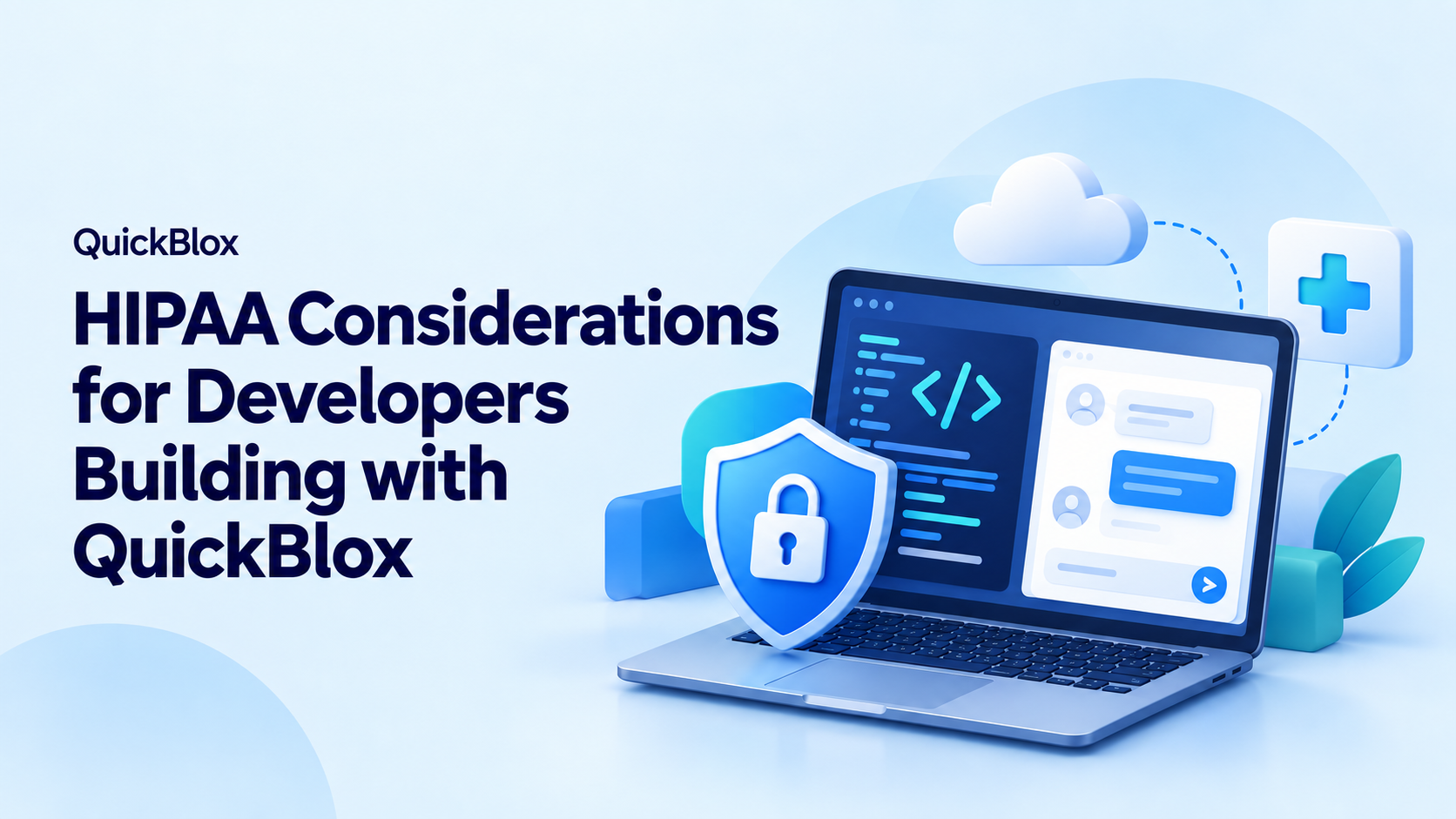
HIPAA applies to healthcare organizations — providers, health plans and insurers, which the law calls covered entities — and to anyone handling protected health information (PHI) on their behalf. If you are building a patient-provider messaging interface, a telehealth platform, or any other healthcare communication tool on the QuickBlox SDK for one of them, that’s you: you are a business associate under HIPAA, and the obligations land on you directly, not only on your customer. If there is no healthcare organization behind your application, HIPAA generally does not apply — though other privacy laws will, including the FTC Health Breach Notification Rule.
Where HIPAA does apply, compliance is shared between you and QuickBlox. QuickBlox handles PHI on your behalf, which makes us a business associate too, and we sign a BAA accordingly — with you if you are the developer, or directly with the covered entity if you are one. That agreement commits us to the infrastructure controls described in the next section. It does not cover the controls that live in your application: access rules, session handling, audit logging, and what you put in a push notification. Neither layer is sufficient alone. Both are required.
What QuickBlox provides
QuickBlox infrastructure is designed to support applications that must meet HIPAA requirements. The following controls are in place at the platform level:
Encryption in transit — all data exchanged between your application and QuickBlox servers, including messages, user credentials, session data, and files, is encrypted using TLS 1.2 or higher.
Encryption at rest — message data, files, and associated metadata stored on QuickBlox servers are encrypted at rest at the storage layer.
HIPAA-eligible hosting options — QuickBlox offers three hosting configurations for healthcare applications:
- HIPAA Shared Cloud Plan — hosted on QuickBlox’s HIPAA-eligible shared AWS infrastructure. Suitable for smaller teams, startups, and MVPs. Includes a signed BAA.
- HIPAA Enterprise Plan — dedicated managed hosting on QuickBlox infrastructure or your own cloud (AWS, GCP, Azure). Includes SLA-backed uptime, a personal account manager, and optional add-ons including High Availability and Disaster Recovery (HA/DR) and dedicated TURN and conference servers. Includes a signed BAA.
- On-Premises Deployment — host QuickBlox on your own infrastructure for control over data location and security configuration. Confirm deployment requirements and BAA coverage with the QuickBlox team before handling PHI.
For production healthcare applications handling PHI, confirm with the QuickBlox team which hosting configuration is appropriate for your use case and compliance requirements. See the QuickBlox HIPAA Hosting page for full details and pricing.
High Availability and Disaster Recovery (HA/DR) — HIPAA requires availability controls for systems handling PHI. Available as an add-on on the HIPAA Enterprise Plan, Multi-AZ deployment launches replicas in separate Availability Zones with continuous data synchronization, designed to keep the database available and recoverable in the event of a zone failure.
Business Associate Agreement (BAA) — QuickBlox will sign a BAA with covered entities and their business associates. A signed BAA is required under HIPAA before any vendor creates, receives, maintains, or transmits PHI on your behalf. All HIPAA hosting plans include a signed BAA. Contact the QuickBlox team to initiate: [quickblox.com/contacts/]
Compliance attestations — QuickBlox has completed a SOC 2 Type II examination. Our infrastructure also supports customers’ requirements to build GDPR-compliant communication solutions.
What you are responsible for as the developer
Infrastructure-level compliance is necessary but not sufficient. The Security Rule (including its Technical Safeguards), the Privacy Rule, and the Breach Notification Rule impose requirements at the application layer that are your responsibility to implement.
Access controls — your application must ensure that only authorised users can access conversations containing PHI. This means implementing role-based access control appropriate to your clinical context (provider, patient, administrator), enforcing authentication before any messaging UI is rendered, and preventing users from accessing dialogs they are not party to. Note that QuickBlox’s back-end platform can be customized to support role-based access, two-factor authentication (2FA), and auto log-off at the platform level — speak to the QuickBlox team about enterprise configuration options.
Automatic session timeouts — automatic logoff after a period of inactivity is an addressable specification under HIPAA’s Technical Safeguards: implement it, or document why it is not reasonable and adopt an equivalent measure. You are responsible for implementing an inactivity timer in your application and ensuring that a session timeout calls the disconnect method on the real-time connection and the destroy method on the session to close the QuickBlox session cleanly alongside your application session.
Audit logging — HIPAA requires that access to PHI is logged and auditable. QuickBlox does not provide application-level audit logs automatically. You are responsible for logging which user accessed which conversation, when, and from which session. In a telehealth context this should cover join events, message access, file access, and logout.
PHI minimization — HIPAA’s minimum necessary standard limits the PHI you use or disclose, though it does not apply to disclosures for treatment or to the patient themselves. Minimizing PHI is still worth doing: it limits your exposure if a message store, log, or integration is ever compromised. Review what your application sends in message bodies and as message custom fields in every send message call. Avoid transmitting PHI that is not required for the clinical interaction.
User consent and notice — patients must be informed about how their communication data is stored, who can access it, and for how long. This is a legal and UX requirement that sits outside the SDK layer. Review your consent documentation before enabling messaging for patients.
Third-party integrations — if your application uses third-party services alongside QuickBlox — analytics platforms, push notification services, logging tools — confirm that each service is HIPAA-eligible and that a BAA is in place before any PHI flows through them. QuickBlox’s BAA covers QuickBlox infrastructure only.
Common PHI exposure mistakes to avoid
Several application-layer mistakes can create PHI exposure even when the underlying QuickBlox infrastructure is correctly configured:
Push notifications — do not include PHI in push notification payloads. Push notifications for new message alerts are delivered through Apple Push Notification Service (APNs) and Firebase Cloud Messaging (FCM). Both services operate outside QuickBlox’s infrastructure and are not covered by your QuickBlox BAA — meaning any PHI included in a notification payload travels through a channel that is not under your compliance agreement. Notification content should be limited to a generic alert — “You have a new message” — with no message content, patient name, diagnosis reference, or any other identifiable health information included. The patient opens the application to read the message in the secure QuickBlox channel.
Message custom fields — message is expandable with custom fields that are passed in each send message call. Review everything your application puts in custom fields and ensure PHI is not inadvertently included in fields intended for routing or metadata.
Logging and analytics — keep message bodies and other PHI out of logs entirely, and out of error tracking and analytics services unless a BAA is in place with that provider. Internal identifiers you need for troubleshooting can be logged, provided the logs stay inside your HIPAA-covered environment, are access-controlled, and fall under your retention policy. Stripping names is not de-identification under HIPAA — if logged data can still be linked back to a patient, it is still PHI.
Session persistence — do not store QuickBlox session tokens or credentials in browser localStorage or device storage beyond the authenticated session. If a user logs out of your application, ensure the real-time connection is dropped by calling the disconnect method and the session is destroyed by calling the destroy method to close the QuickBlox session cleanly. Leaving a QuickBlox session open after a platform logoff creates a PHI exposure window.
Non-HIPAA-eligible configurations — confirm your hosting plan and BAA coverage before moving from development to production. If your QuickBlox plan is not covered by a signed BAA, no PHI should pass through it.
This list covers the most common PHI exposure points in communication applications and is not exhaustive. A formal compliance review will identify additional requirements specific to your application and use case.
Before you deploy: compliance checklist
Use this checklist before deploying any QuickBlox-powered application that will handle PHI in a production environment. This is not a comprehensive HIPAA audit — it covers the most critical application-layer controls for communication applications specifically.
Infrastructure
- QuickBlox hosting plan confirmed as HIPAA-eligible for your use case
- Signed BAA in place with QuickBlox before any PHI flows through the platform
- BAA confirmed with each third-party service that touches PHI (analytics, push notifications, logging)
Authentication and access
- Users are authenticated before any messaging UI is rendered
- Role-based access controls implemented — patients can only access their own conversations
- Session timeout and automatic logoff implemented and tested
- Real-time connection disconnect method and session destroy method are called on logoff and timeout
Data handling
- PHI is not included in push notification payloads
- Message extension objects reviewed — no PHI in metadata fields
- Message bodies reviewed for PHI minimization—only clinically necessary information transmitted
- PHI-bearing fields are not passed to logging, analytics, or error tracking services
Audit and consent
- Application-level audit logging implemented — records who accessed which conversation and when
- Patient consent documentation covers the messaging channel, including data storage and retention
- Data retention and deletion policies defined and implemented
Planning a healthcare application?
Contact the QuickBlox team to discuss the right hosting option, deployment requirements, and BAA coverage.
Further reading
The following pages in the QuickBlox Knowledge Center cover the underlying HIPAA concepts referenced in this document:
- What is HIPAA Compliance? →
- What is a Business Associate Agreement (BAA)? →
- What Are HIPAA Technical Safeguards? →
- What Makes a Telehealth Platform HIPAA-Compliant? →
- What is a HIPAA-Compliant Chat API? →
- What is HIPAA-Compliant Video Conferencing? →
Last reviewed: September 2026. This document is reviewed periodically to reflect changes to QuickBlox platform capabilities and HIPAA guidance. It is not a guarantee of compliance and does not constitute legal advice.