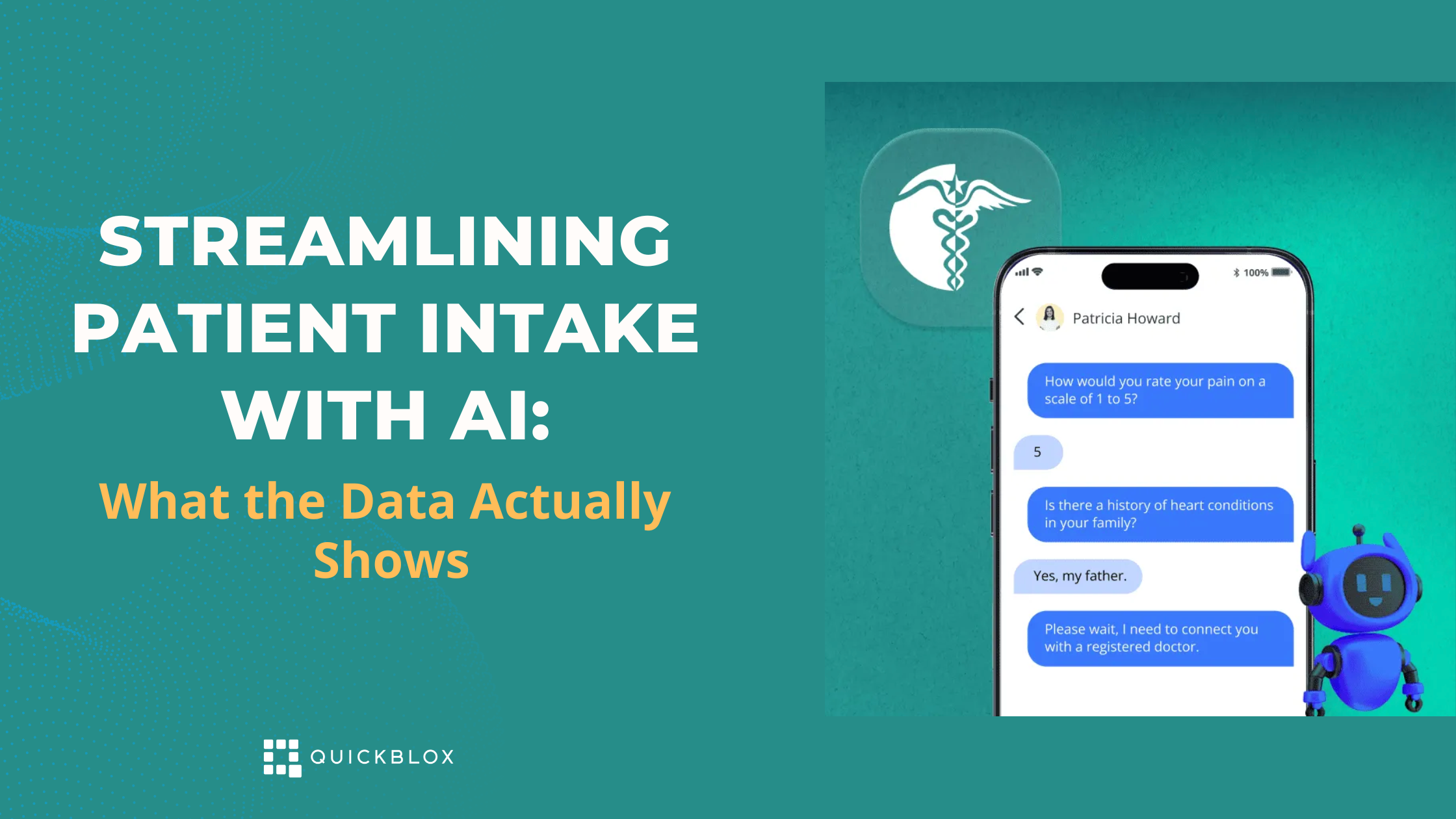
Summary: The evidence base for AI patient intake is maturing — and there’s now enough data from peer-reviewed research and real clinical deployments to give an honest answer to the question most clinics and healthtech teams are actually asking: does it work, and what does it take to make it work well? This blog collates the findings, including what deployments got right, what they got wrong, and the four implementation factors that most consistently determine whether an AI patient intake system delivers on its promise.
Table of Contents
Introduction
If you’re evaluating AI patient intake for your clinic or healthtech platform, you’re making a decision in a noisy market. Vendors promise faster check-ins, reduced administrative burden, better data quality, and improved patient satisfaction — often without much to back those claims up beyond demo videos and case studies written by their own marketing teams. The honest question any decision-maker should be asking is simpler: does this actually work, and what does it take to make it work well?
The evidence base for AI patient intake is still maturing — this is a technology that has moved from experimental to operational relatively recently, and rigorous peer-reviewed studies are fewer than the vendor landscape would suggest. But there is enough data now, from peer-reviewed research and real deployment outcomes, to give a specific and honest answer to both questions. That’s what this blog attempts to do — collate what the evidence actually shows, including what deployments got right and what they got wrong, so that clinics and healthtech teams can make a more informed decision. For a full explanation of what AI patient intake is and how to evaluate solutions, see our AI-Powered Patient Intake: Complete Guide.
Key Takeaways
- One peer-reviewed study found that algorithmically enhanced intake identified approximately four times as many potential clinical intervention opportunities as standard paper forms—although the study was limited in scope and setting.
- A peer-reviewed study of 135,393 appointments reported a 50.7% reduction in no-shows following implementation of an AI prediction model, while other deployments have reported smaller but meaningful reductions.
- One of the recurring patient intake automation challenges is that systems require UX testing and iteration after deployment; they do not arrive optimized for every patient population or clinical workflow.
- EHR integration depth is a major factor in whether time savings materialize—surface-level API connections do not deliver the same operational benefits as bidirectional data flow.
- HIPAA compliance architecture must include the AI processing layer, not only the hosting environment, with appropriate safeguards and BAA coverage across the complete data flow.
The case for changing the intake process starts with a straightforward operational reality. A time and motion study published in Annals of Internal Medicine found that for every hour of direct patient care, ambulatory physicians spend nearly two additional hours on EHR and desk work — and intake is one of the most persistent contributors to that figure. Patients arrive early to complete forms that ask for information they’ve already provided. Staff manually transfer handwritten data into EHR systems under appointment pressure. Insurance verification happens by phone. By the time a clinician enters the consultation, a significant proportion of the available appointment time has already been consumed by preparation work that didn’t require clinical judgment.
The downstream consequences are more serious than they appear. Manual data entry introduces errors that propagate through the clinical record — incorrect dosing, delayed treatment, insurance rejections. Missed appointments, many of which could have been predicted and prevented, cost the US healthcare system an estimated $150 billion annually according to widely cited industry estimates. And the patient experience of a slow, repetitive intake process sets a tone before care has even begun.
What makes that last point more significant than it first appears: a study published in Medicine (Zhang et al) found that actual waiting time had no statistically significant effect on patient satisfaction in outpatient settings — but expected waiting time, perceived waiting time, and tolerance waiting time all did. The implication is direct: an intake process that manages patient expectations from the very first touchpoint shapes satisfaction outcomes before a clinician is ever involved. Getting intake right isn’t just an operational efficiency question — it’s a patient experience question that begins the moment someone interacts with your system. For how intake fits into that broader patient access strategy — from first contact through post-visit follow-up — see How AI Is Transforming the Digital Front Door in Healthcare.
These are the outcomes against which AI patient intake should be evaluated: whether it reduces administrative work, improves information quality and creates a better patient experience in practice. If you’re new to this space, it’s worth understanding how these steps connect into a broader workflow, see How AI is Powering Workflow Automation in Healthcare and Telehealth.
What the Research Shows
Peer-reviewed studies specifically examining AI patient intake are still relatively limited — which is itself a useful data point for anyone evaluating vendor claims. Most of what circulates as “evidence” in this space is vendor-produced case study material rather than independently validated research. What the published literature does show, however, is specific enough to be useful.
Study 1: Algorithmically enhanced intake identifies significantly more clinical opportunities
Research conducted by the Auburn University Harrison School of Pharmacy evaluated the impact of clinical decision support system (CDSS)-enhanced digital intake forms in a pharmacist-led ambulatory care clinic. Patients completed intake via a mobile application embedded with an algorithm that asked individualized follow-up questions based on age, sex, and reported conditions — algorithmically guided decision logic layered onto the intake process.
Key findings:
- Patients using enhanced digital intake had an average of 1.8 potential clinical interventions identified per visit, compared to 0.44 for those using standard paper forms — a fourfold difference
- Two of the most commonly identified intervention types — thyroid screening referrals and vaccination needs — were identified in zero patients using paper forms
- The intake logic surfaced clinically significant gaps that the standard process consistently missed
Worth noting: the study was conducted in a single pharmacy clinic, the sample lacked demographic diversity, and the setting differs from a telehealth platform. The findings indicate that structured, algorithmically guided intake can identify more clinically relevant information than standard paper forms in this setting, although further research is needed to establish whether the results generalize across other clinical environments.
Study 2: Digital intake is acceptable to patients — but requires UX iteration
A 2024 qualitative study from University Hospitals of Cleveland (Segall et al) evaluated patients’ experience with electronic intake forms in an outpatient integrative health setting, interviewing 10 participants across two clinics. Patients rated the forms as acceptable and feasible — they did not add burden or generate meaningful resistance — and considered them valuable for communicating health information to their providers. The study’s authors noted that minor refinements to wording and structure were suggested by participants, and that further implementation across a common EHR system remained a next step.
This pattern of iterative refinement after initial deployment appears consistently across deployment accounts more broadly. AI intake systems arrive with sensible defaults, but those defaults are rarely calibrated to a specific patient population or clinical workflow from day one. Organizations that build a structured review cycle into their deployment plan from the outset tend to see stronger outcomes than those that treat go-live as the finish line. For a broader look at how AI conversational tools are being deployed in clinical settings today, see AI Medical Chatbots: What They’re Actually Doing in Healthcare Today.
What Deployment Data Is Showing
Beyond the peer-reviewed literature, a growing body of deployment data from real clinical settings is starting to build a more detailed picture of what AI patient intake delivers in practice. This data comes from a mix of sources — some independently published, some vendor-reported — and should be read with that context in mind. Taken together, however, the direction of travel is consistent.
Visit time and preparation quality
The most consistent operational benefit reported across AI intake deployments is time recovered at the consultation itself. When intake logic is working well and EHR integration is functioning correctly, the clinician opens the consultation with a structured patient summary already waiting — symptoms, history, medications, and consent collected and organized before they are involved. The preparation work has been done; the appointment can begin with care rather than administration.
This is precisely what the peer-reviewed evidence suggests should happen. The Auburn study found that algorithmically guided intake captured significantly more clinically relevant information than standard forms — meaning the summary waiting for the clinician is not just faster to produce, but more complete. The practical result, reported consistently across deployment accounts, is a reduction in repetitive questioning during the consultation and better use of the time available for actual clinical judgment.
No-show reduction
The strongest independent evidence for AI patient intake comes from appointment management — specifically, AI-powered no-show prediction and automated outreach. A peer-reviewed study published in the Journal of Medical Internet Research evaluated an AI no-show prediction model deployed across a primary healthcare network in the UAE, analyzing 135,393 appointments before and after implementation.
Key findings:
- No-show rates fell by 50.7% following implementation of the AI prediction model
- Patient wait times decreased by an average of 5.7 minutes overall, with some sites achieving up to 50% wait time reduction
- The model enabled clinic coordinators to proactively contact high-risk patients and reallocate slots to walk-in patients
Total Health Care, a US FQHC, reduced high-risk patient no-shows by 34% using an AI prediction model with automated outreach, filling 309 additional appointments in 45 days without added staff.
Four Lessons From the Patient Intake Evidence
The evidence points in a consistent direction: AI patient intake delivers meaningful results when deployed well and disappointing results when it isn’t. The difference between those two outcomes is rarely the AI capability itself—it’s how organizations address the most common patient intake automation challenges. The full set of standards that determine whether a healthcare chatbot deployment holds up in production is covered in Healthcare Chatbot Best Practices — what follows are the four factors the intake evidence most consistently identifies.
1. Treat deployment as an iterative process, not a one-time implementation
A consistent pattern across deployment accounts is that AI intake systems don’t arrive optimized for your specific context. Question wording that works in one clinical setting creates friction in another. Intake flows that feel logical to a development team feel disjointed to patients completing them under stress. EHR integration that functions technically doesn’t always function practically. The organizations most likely to achieve strong outcomes are those that build a structured review and refinement cycle into their deployment plan from the start — typically reviewing conversation logs, gathering clinician and patient feedback, and updating intake logic at defined intervals — rather than treating go-live as the finish line.
This is consistent with what the peer-reviewed literature suggests. The Segall et al. study found that patients using electronic intake forms offered minor but meaningful suggestions for improvement — adding open-ended questions, clearer definitions, and save functions — indicating that even well-designed systems benefit from iterative refinement based on real user experience.
Key lesson: Build a defined review and refinement cycle into the deployment plan, using patient and clinician feedback to improve intake questions and flows after go-live.
2. EHR integration depth affects whether time-savings materialize
The core promise of AI patient intake — that the clinician opens the consultation with a structured summary already waiting — depends heavily on one thing: the system’s output flowing directly into the clinical record before the consultation begins. When that integration works, preparation time can be reduced, and appointment time is used for care. When it doesn’t — when intake data lands in a separate queue, requires manual reconciliation, or needs to be re-entered by staff — the potential time-savings diminishes and the system adds a step rather than removing one.
The Auburn study supports this indirectly: the team encountered technical difficulties with PDF generation that interrupted clinic workflow, and recruitment had to be scaled back as a result. The implementation difficulties illustrate how technical friction at the integration point can limit the practical value of digital intake.
Key lesson: Validate bidirectional data flow against your specific EHR setup before committing — not from API documentation, but from a working test with real data in your actual environment.
3. Configure intake logic for your clinical context — don’t apply a generic algorithm
The Auburn study illustrates how intake logic can be configured around characteristics of the intended patient population. Its algorithm didn’t ask every patient the same questions — it asked each patient the questions relevant to their age, sex, and reported conditions. That tailored questioning was a central feature of the intervention associated with the fourfold difference in identified clinical opportunities. The scale of the gap is illustrated by two intervention types — thyroid screening referrals and vaccination needs — that were completely missed by standard paper forms, identified in zero patients, but surfaced consistently by the AI-enhanced intake.
Different clinical settings require different intake questions, terminology, consent requirements and data fields. A mental health platform, for example, will need different question sequencing from an urgent-care or chronic-disease service. Intake flows should therefore be configurable rather than applying one fixed sequence across every use case. For the urgency assessment, routing and escalation decisions that follow intake, see How AI Agents Support Patient Triage Workflows.
Key lesson: During vendor evaluation, test the system with realistic patient scenarios from your specific clinical context — not the curated demo scenarios the vendor has optimized for. The gap between those two experiences tells you everything about how configurable the system actually is.
4. HIPAA compliance architecture must be designed in from the start
When an AI patient intake system uses an NLP or LLM service to create, receive, maintain or transmit ePHI on behalf of a covered entity or business associate, that service must be included in the HIPAA risk analysis and appropriately covered by a BAA. HIPAA-compliant hosting does not automatically establish compliance for a separate AI processing service handling the same data.
The compliance architecture needs to be designed across the full data flow — from patient input through AI processing, structured output, EHR integration, and data storage — before go-live, not assembled piecemeal as components are added. For a full discussion on what is required, see our guide, Is Your AI Medical Assistant HIPAA Compliant?
Key lesson: Ask every vendor to specify exactly which components of their system are covered under their BAA and what the scope of that coverage includes. If the answer is vague, treat that as a red flag.
Conclusion
The evidence on AI patient intake is specific enough to be useful and honest enough to be trusted. It works — but the deployments that deliver meaningful results are the ones that went in with realistic expectations, built iteration into the plan, and chose infrastructure that handles compliance and integration complexity as a baseline rather than an afterthought.
QuickBlox’s AI Agents for healthcare are built for exactly this environment — HIPAA-compliant AI patient intake, that can be integrated in your own platform or used within Q-Consultation, our white -abel telehealth platform, with the AI, messaging, and hosting layers covered under a single BAA. If you’re working through the implementation questions this blog raises, we’re happy to share what we’ve seen work in practice.
Talk to a sales expert
Learn more about our products and get your questions answered.
Contact sales
Resources on AI in Healthcare
The following resources from the QuickBlox Knowledge Center go deeper on the evidence, implementation considerations, and compliance questions this blog raises.
 AI Agent — automate conversations and workflows. Now available on Free plan