Summary: This article explains how developers can evaluate and choose a HIPAA-compliant chat API when building healthcare applications. It explores compliance considerations, infrastructure options, and security features required to support secure patient communication.
Table of Contents
Introduction
Most developers don’t think about compliance until messaging is already on the roadmap. By then, the question isn’t whether to add chat — it’s whether the API they were planning to use can actually support a healthcare environment.
The answer, more often than not, is no. General-purpose messaging APIs are built for speed and scale, not for the access controls, audit logging, and encrypted storage that healthcare applications require. Swapping one in without understanding those gaps can create serious compliance exposure — and retrofitting a messaging layer after the fact is significantly harder than choosing the right one at the start.
This guide is for development teams that are past the “do we need messaging” conversation and into the “how do we evaluate our options” stage. It covers the practical factors that matter when selecting a HIPAA-compliant chat API — from compliance obligations like Business Associate Agreements to infrastructure flexibility and security safeguards — and what to look for before committing to a platform.
If you’re still working through the broader architecture of a healthcare application, our article on building a HIPAA-compliant telehealth app covers those decisions in more detail.
Key Takeaways
- Messaging creates unique compliance exposure in healthcare. Unlike other app features, a patient conversation can include protected health information whether the developer intended it or not.
- Evaluating a HIPAA-compliant chat API means assessing four criteria: BAA availability, infrastructure deployment options, technical safeguards, and build-vs-buy fit — not just whether a provider claims to be compliant.
- BAA availability is the first question to ask. A messaging API without one is a compliance liability regardless of its technical capabilities.
- “HIPAA compliant” in a provider’s marketing doesn’t guarantee all safeguards are enabled by default. Encryption, audit logging, and access controls should be verified specifically — and at the right plan tier.
- For teams with tight timelines or limited dev capacity, a ready-made healthcare communication platform can significantly reduce time to launch while still allowing customization through APIs and SDKs.
Why Messaging Is a Compliance Risk
Most healthcare application features touch patient data in predictable, controlled ways. A scheduling module books appointments. A records viewer displays clinical notes. The data flows are defined, the access points are limited, and the compliance boundaries are relatively easy to draw.
Messaging is different. By design, it’s open-ended. A patient asking a follow-up question after a visit might mention a diagnosis, a medication, or a symptom — none of which the developer anticipated when wiring up the chat interface. That conversational flexibility is exactly what makes messaging valuable in healthcare, and exactly what makes it a compliance risk.
Once protected health information enters a conversation, the entire messaging layer — storage, transmission, access controls, audit logging — has to meet HIPAA’s technical security requirements. That’s true whether the message was intended to carry PHI or not.
To understand how deeply messaging is now embedded across clinical workflows — from post-visit follow-ups to chronic condition management — see HIPAA-compliant chat in healthcare: messaging workflows. For a full breakdown of what the compliance requirements mean in practice, see our guide on what a HIPAA-compliant chat API is. For teams already familiar with both, the next section covers what to look for when evaluating providers.
Key Factors to Consider When Choosing a HIPAA-Compliant Chat API
Not every messaging platform is built for healthcare, and the differences between providers go deeper than a compliance checkbox. The wrong choice can create problems that are expensive to fix — a BAA that doesn’t exist when an audit arrives, infrastructure that can’t be deployed where your organization needs it, or security gaps that only become visible after a breach.
The factors below cover the practical evaluation criteria that tend to surface early when development teams are selecting a chat API for healthcare applications. Teams comparing specific platforms may also find it useful to review our guide to top HIPAA-compliant chat apps in 2026, which looks at several commonly used solutions side by side.
1. Confirm the Provider Will Sign a Business Associate Agreement (BAA)
Under HIPAA, any technology vendor that processes or stores protected health information on behalf of a covered entity is considered a Business Associate — and is legally required to sign a Business Associate Agreement (BAA) before handling that data.
For messaging, that obligation kicks in the moment a patient conversation could reasonably include PHI. The problem is that many general-purpose chat APIs are built for consumer applications and have no mechanism for signing a BAA. Some will tell you this upfront. Others won’t mention it until you ask.
Confirming BAA availability should be the first question in any vendor evaluation — not because it’s the most technically interesting factor, but because without it, everything else is moot. A messaging API with excellent security features and no BAA is still a compliance liability.
2. Understand Where the Messaging Infrastructure Can Be Deployed
Infrastructure flexibility matters more in healthcare than in most other verticals. Many healthcare organizations have specific requirements about where patient data can live — driven by internal security policies, enterprise cloud agreements, or regulatory expectations that go beyond HIPAA itself.
A messaging API that only runs on the provider’s proprietary cloud may work fine for some teams, but creates problems for organizations that need to deploy in AWS, Microsoft Azure, or their own private cloud environment. Finding that out late in the integration process — after architecture decisions have already been made — is an avoidable and costly mistake.
Early in the evaluation process, it’s worth asking explicitly: what deployment options does the provider support, and what does each option mean for data residency and infrastructure control?
3. Verify That the Platform Supports HIPAA Technical Safeguards
A provider signing a BAA establishes a compliance relationship — it doesn’t automatically mean their platform has the technical capabilities to support it. These need to be verified separately.
For messaging systems handling PHI, the relevant HIPAA technical safeguards typically include encryption for data in transit and at rest, user authentication and role-based access controls, audit logs that record who accessed what and when, and secure storage and backup mechanisms.
The risk here is assuming that “HIPAA-compliant” in a provider’s marketing materials means all of these are implemented and configurable. In practice, implementations vary. Some platforms encrypt data in transit but not at rest. Some offer audit logging as an enterprise add-on rather than a default. Asking for a specific breakdown of which safeguards are included — and at which plan tier — avoids surprises during a compliance review.
4. Consider Whether a Ready-Made Healthcare Communication Solution Changes the Build Decision
Most development teams default to evaluating APIs because they assume they’ll be building the communication layer themselves. That’s often the right call — but it’s worth explicitly considering whether a prebuilt healthcare communication platform changes the calculus before committing to a custom integration.
Some providers offer ready-made solutions that combine messaging, video consultations, and compliance-ready infrastructure in a single platform. For teams with tight launch timelines or limited capacity to build and maintain communication infrastructure, starting with a prebuilt solution can significantly reduce time to launch — while still leaving room to extend or customize through APIs and SDKs as the product matures.
The build-vs-buy decision isn’t just about cost. It’s about where your team’s development time is best spent at this stage of the product.
Example: Building HIPAA-Compliant Messaging with QuickBlox
For development teams working through the evaluation criteria above, QuickBlox is one HIPAA-compliant platform worth looking at closely — particularly for teams building patient portals, telehealth applications, or internal communication tools for clinical environments.
On the compliance side, QuickBlox offers a signed BAA through its enterprise plan — satisfying the first and most fundamental requirement for healthcare messaging. The platform supports deployment across cloud environments including AWS and Microsoft Azure, with private cloud and on-premise options available for organizations that need tighter control over data residency. For teams that have specific infrastructure requirements driven by internal policy or regulatory expectations, that flexibility matters.
At the feature level, the platform includes encrypted message transmission, user authentication, role-based access controls, and activity logging — the technical safeguards that healthcare messaging systems are expected to support. These aren’t positioned as add-ons; they’re part of the core infrastructure developers build on.
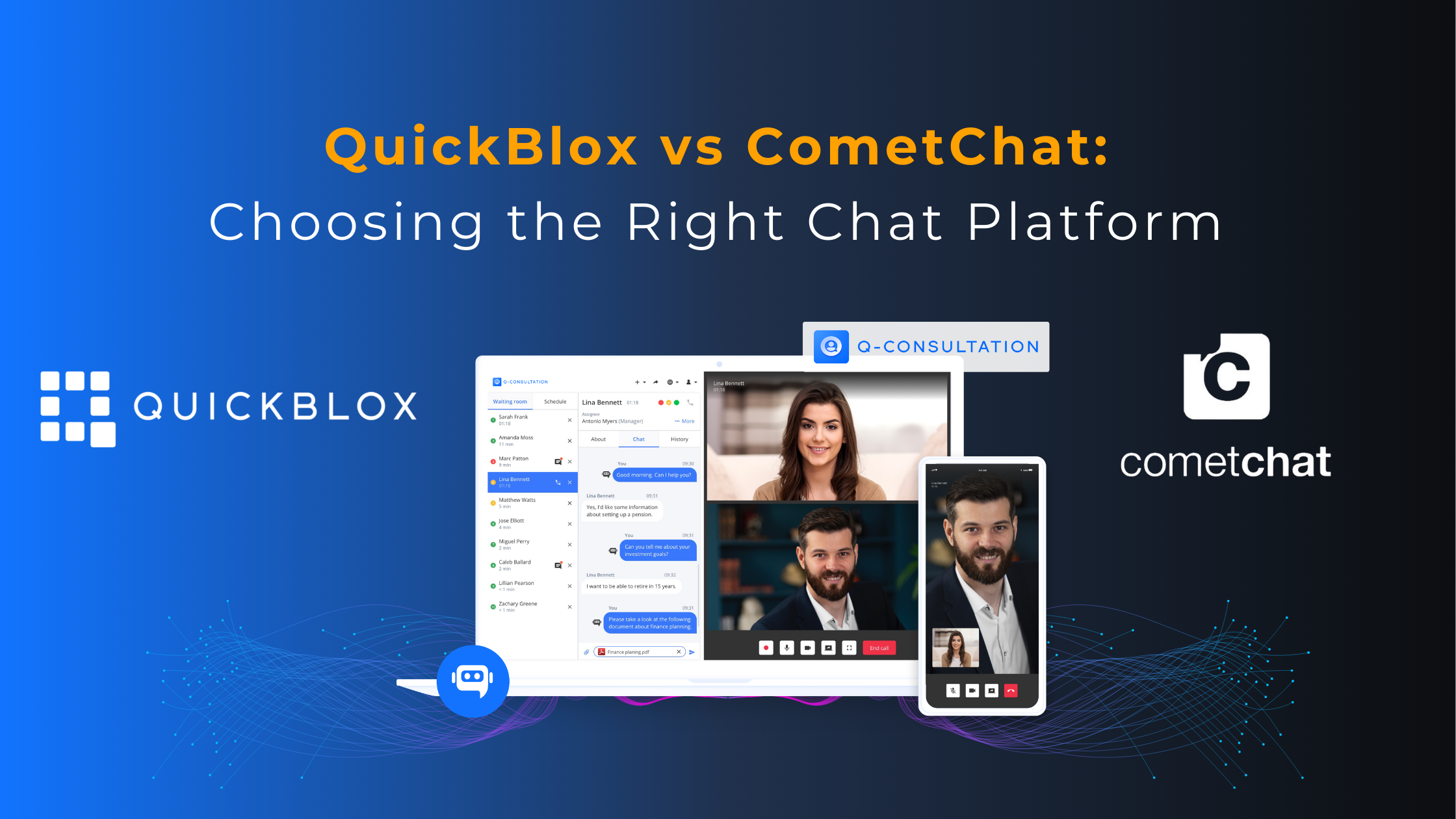
For teams evaluating the build-vs-buy question raised in Factor 4, QuickBlox also offers Q-Consultation — a ready-made telehealth platform that combines messaging with video consultations and a virtual waiting room. It’s a practical starting point for organizations that want to launch quickly without building every layer of the communication stack from scratch, while still retaining the ability to customize and extend through APIs and SDKs as the product evolves.
Conclusion
Choosing a messaging API for a healthcare application is fundamentally a different decision than choosing one for a consumer product. The compliance obligations are real, the consequences of getting it wrong are significant, and the differences between platforms aren’t always visible until you’re deep into an integration.
The four factors covered in this guide — BAA availability, infrastructure flexibility, technical safeguards, and build-vs-buy considerations — won’t make the decision for you, but they give your evaluation a structure that’s harder to shortcut past. The teams that run into problems with healthcare messaging usually didn’t miss something obscure. They skipped one of these questions because they assumed the answer was yes.
If you’re ready to explore what HIPAA-compliant messaging looks like in practice, you can try the QuickBlox Chat API for free and test secure messaging integration in your own environment before making a commitment.
Have Questions? Need Support?
Join the QuickBlox Developer Discord Community, where you can share ideas, learn about our software, & get support.
Join QuickBlox Discord
Additional Resources
If you’re building healthcare applications or evaluating communication tools for telehealth platforms, the following guides provide deeper explanations of the compliance requirements discussed in this article: